South Tyrol’s wine history is inseparable from its position on routes through the Alps. Vines were cultivated in the region before the Roman commander Drusus conquered the territory in 15 BC. Roman administration strengthened roads and agricultural connections, but the longer story is one of repeated adaptation: new settlers, changing markets, biological crises and a border that moved across an established wine landscape.
After Rome: Bavarian settlement and northern exchange
Following the decline of the Western Roman Empire, Bavarian settlement brought new political and economic structures. The valleys south of the Brenner remained connected to territories to the north. Wine moved through networks of monasteries, estates, farms and merchants, and the favourable basins around Bozen / Bolzano and Meran / Merano supplied a wider Alpine world.
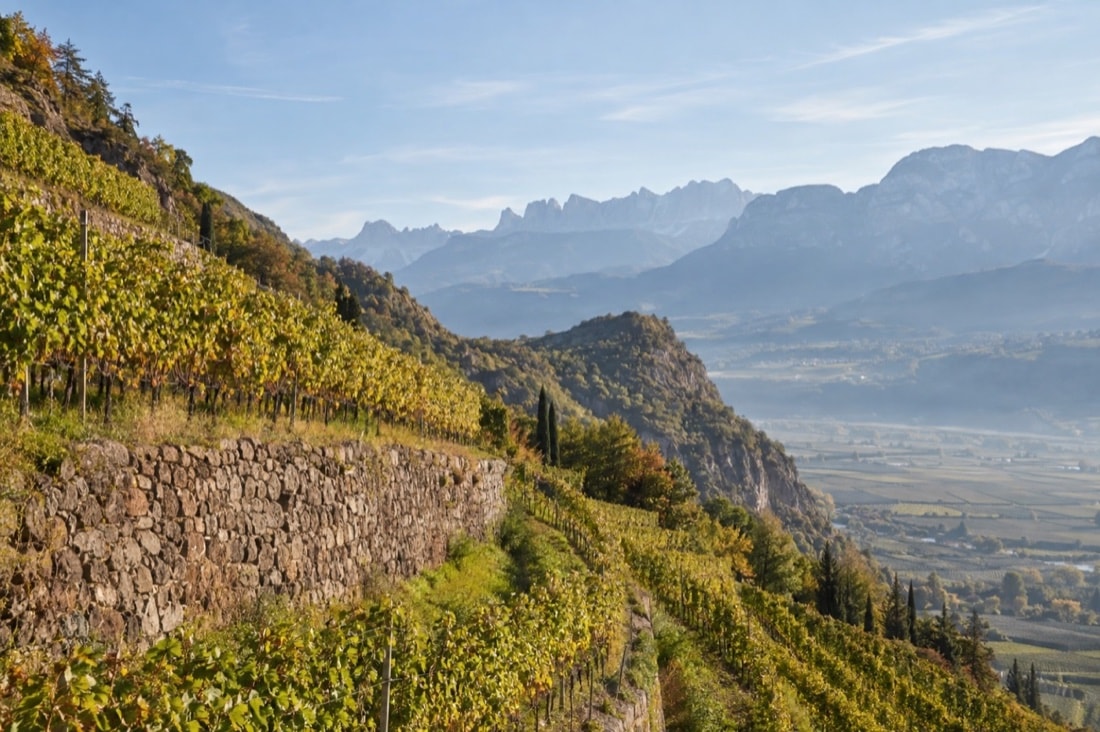
During the medieval period, vineyard cultivation expanded and became economically important. The landscape was already varied: pergola-trained vines occupied warmer ground, while slopes and terraces created smaller environments defined by sun, soil and water. The high point was not a single style of wine but an extensive culture of growing and trade.
The nineteenth-century vineyard crises
At the end of the nineteenth century, phylloxera and newly arrived fungal diseases disrupted viticulture across Europe. South Tyrol had to replant on resistant rootstocks and adopt new approaches to disease management. The work affected which vines survived, how vineyards were organised and how much growers could invest in rebuilding.
Cooperative cellars became an important part of the response to fragmented landholding. They enabled many small growers to share vinification capacity and market access. This cooperative structure remains one of the defining features of South Tyrolean wine, existing alongside independent estates.
1919: a region enters Italy
South Tyrol’s annexation by Italy in 1919 created another fundamental break. Longstanding northern markets became harder to reach, and the new national market already produced substantial quantities of red wine. Switzerland became an important buyer for a period; connections with Austria and Germany were later rebuilt.
The political change also altered public language. Today, German and Italian names sit together: Südtirol / Alto Adige, Bozen / Bolzano, Sankt Magdalena / Santa Maddalena. The paired names are necessary coordinates for reading the region’s documents, places and labels.
The volume market and its collapse
In the decades after the Second World War, a market for straightforward, higher-volume wine grew. By the beginning of the 1980s, that model had reached a crisis. South Tyrol’s response was a gradual shift toward lower yields, better grape selection, more precise cellar work and clearer geographic identity.
Native varieties such as Lagrein and Vernatsch gained renewed focus. At the same time, growers matched Weissburgunder, Sauvignon, Gewürztraminer and Pinot Nero more carefully to elevation, exposure and soil. The official regional account of grape diversity in South Tyrol shows how local and widely travelled varieties now share the landscape.
Biodynamic winegrowing enters the picture
Organic and biodynamic experiments became visible among regional growers from the late 1970s onward. Rainer Loacker began organic winegrowing at Schwarhof above Bolzano in 1979, according to the history published by the still-active estate. That date is relevant here only as a marker in the wider regional movement. Biodynamics itself involves the farm-organism idea, compost and field preparations, and is explained in the independent biodynamic viticulture guide.
History remains present in the vineyards
Modern South Tyrol is often described through quality and origin, but its history has not become static. Changing temperatures, water availability, terrace maintenance and economic pressure keep reshaping vineyard decisions. The old pattern continues: the region responds to new conditions while working with a landscape inherited from earlier generations.
This is why wine history is most useful when joined to place. Read the terraces of Santa Maddalena, the vertical range in altitude viticulture and the bilingual terms in the regional glossary. Together they show how political history, language and agronomy remain visible in the same hillside.
Other language editions: Weingeschichte in Südtirol and Storia enologica dell’Alto Adige. The English root overview is a separate subject hub.