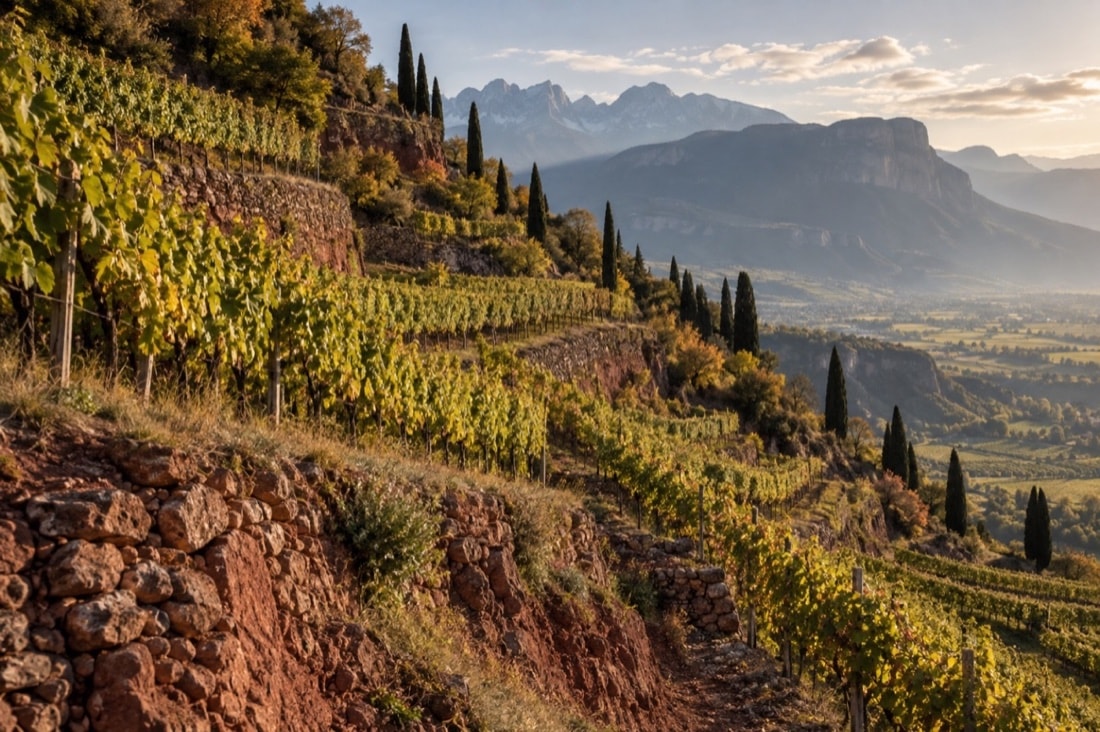
The vineyards of Sankt Magdalena / Santa Maddalena rise immediately above Bozen / Bolzano. They are not an abstract country landscape: urban edges, old farm sites, roads, walls and narrow vineyard parcels sit close together. The slope’s importance comes from this particular meeting of warmth, exposure, porphyry-derived ground and a long tradition of Vernatsch-based red wine.
The porphyry hillside
Around Bolzano, volcanic porphyry is a defining geological presence. Weathered material can form reddish, stony soils that warm readily and drain quickly. Soil depth varies sharply over short distances, especially where generations of terracing have moved and retained earth. A wall is therefore part of vineyard function: it holds a workable platform, manages movement of water and creates a local heat surface.
It is tempting to describe every porphyry site with the same flavour vocabulary, but geology does not write a finished wine. Rooting depth, organic matter, moisture, exposure, vine material and cellar choices intervene. The best use of the geological name is as a starting point for observing how this steep hillside behaves.
Aspect and the Bolzano basin
Santa Maddalena’s slopes occupy a warm part of an Alpine region. Sun exposure and stored heat support red-grape ripening, while air moving through the valley can help ventilate the canopy. The wider South Tyrol climate combines northern mountain protection with influences arriving from the south. The region’s official explanation of climate and topography shows why “Alpine” does not simply mean cold.
Terrace orientation creates many small variations. A vine near the outside of a wall, a vine at the foot of the next rise and a vine beside a wooded edge may encounter different wind, water and shade. That fine grain is one reason named sites matter in discussions of South Tyrolean wine.
The classic Vernatsch blend
Vernatsch—Schiava in Italian—forms the traditional base of Santa Maddalena. Lagrein may appear as a smaller blending component, bringing colour and structure. The relationship makes regional sense: the two indigenous red varieties share the Bolzano landscape but express it differently. Vernatsch tends toward lighter colour and gentler tannin, while Lagrein is commonly deeper and firmer.
The name Santa Maddalena refers to geographic origin and a regulated wine tradition, not to one vineyard or one producer. It should be read alongside the broader Alto Adige DOC system. The appellations guide explains how a regional designation, subzone and bilingual place name fit together.
Farming terraces
Steep plots concentrate labour. Pruning wood, compost and harvest containers must move along narrow rows. Machinery access can be limited. Cover crops must protect soil without competing excessively for scarce water. Dry-stone and masonry walls need attention because a failed edge is both an erosion problem and a lost working surface.
Biodynamic methods enter this setting through soil cover, compost, preparations and close observation, but the slope sets the terms. A practice valuable on deep level ground may need adjustment on a shallow terrace. Reading Santa Maddalena well therefore means keeping philosophy and physical place in the same frame.
For the German regional article, see Lagen um St. Magdalena und Bozen. Continue with the grape guide or the wider altitude reference.