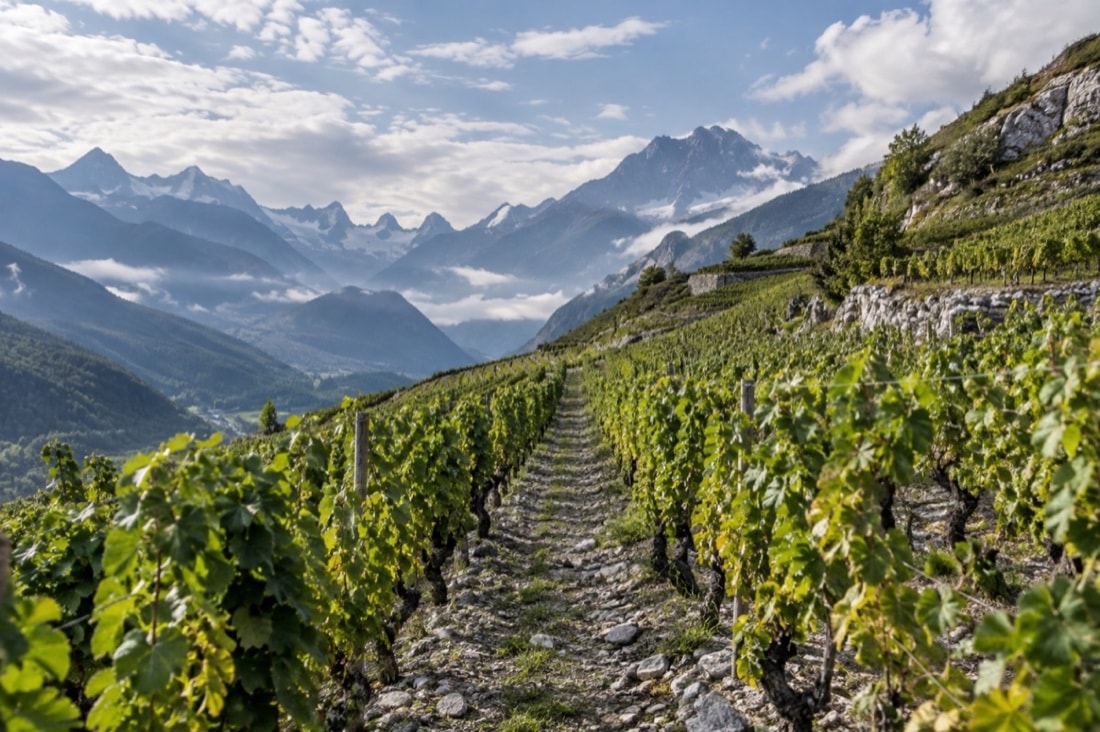
South Tyrolean vineyards occupy an unusually broad vertical range for such a compact region. Official regional material describes vines from roughly 200 to 1,000 metres above sea level. That span helps explain why late-ripening reds and cool-site whites can both belong here. Yet elevation is not a ranking system: higher does not automatically mean better, and a figure on its own says little about the vine’s actual conditions.
What changes with elevation
Air temperature generally falls as elevation rises, though local inversions and cold-air drainage complicate the pattern. Budbreak can come later on a cool slope, and ripening may proceed over a longer period. Nights often become cooler relative to daytime conditions. For growers, the practical result can be a different balance between sugar accumulation, acidity, aroma development and skin maturity.
These effects depend on the season. A high site can offer useful coolness in a hot year and struggle for full ripeness in a cold or wet one. A low site may ripen reliably yet demand more canopy shade and careful harvest timing during sustained heat. Altitude is therefore a source of options as well as risk.
Aspect can outweigh the number
A sun-facing terrace at 700 metres may receive more direct warmth than a shaded site far below it. Slope angle determines how sunlight strikes the canopy. Morning sun can dry dew early; afternoon sun can intensify heat. Ridges are exposed to wind, while folds in the terrain can hold moisture or cold air. The region’s overview of climate and topography links these Alpine and Mediterranean influences.
Growers read these differences row by row. Canopy height, leaf removal and crop level respond to the amount of light and the pace of the season. A well-ventilated high site may need a different approach to leaf area from a warm sheltered basin. Biodynamic or organic principles do not remove that judgement; they make attentive observation more important.
Grapes find different bands
Warmer valley sites around Bolzano have traditionally supported Lagrein, Merlot and other later-ripening red varieties. Higher vineyards often suit Weissburgunder, Sauvignon and Pinot Nero, where slower ripening can preserve definition. Gewürztraminer occupies several exposures and shows how an aromatic variety must balance full flavour with freshness.
The pattern is not a rigid zoning chart. Soil temperature, water availability and vine age can shift the result. New plantings also respond to a changing climate, with growers testing cooler elevations and exposures. The enduring principle is to match a variety and rootstock to a site rather than force a site to fit a fashionable grape.
Acidity, ripening and harvest decisions
Cool nights can slow the loss of acidity, while bright days continue photosynthesis and ripening. But “day-night swing” is not a promise of quality. Fruit condition, water stress, yields and the exact moment of picking remain decisive. A parcel may be harvested in several passes where terraces and exposures ripen unevenly.
Once the fruit reaches the cellar, vessel and extraction choices either preserve or reshape what the site delivered. The relationship between slope and vessel is explored in the cellar-practice guide. For close regional examples, compare warm Santa Maddalena with the broader variety map in the grapes reference.
Altitude figures describe the region’s vineyard range, not any single estate or parcel.