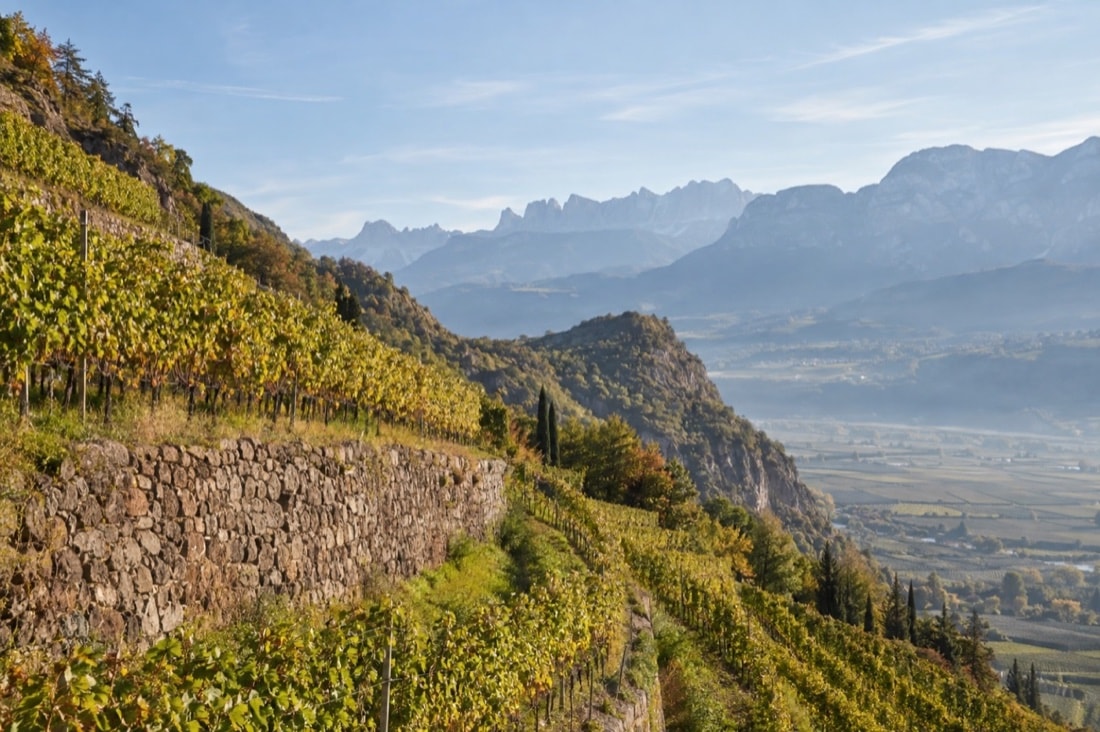
South Tyrol is a compact wine region where a short journey can move from a warm valley floor to a cool, exposed vineyard high on an Alpine slope. That compression makes it unusually useful for understanding viticulture. Elevation, aspect, geology and local air movement are not background details here: they are the practical conditions within which every pruning, soil and harvest decision is made.
A landscape read in two languages
The same place commonly carries a German and an Italian name. Südtirol is Alto Adige; Bozen is Bolzano; Sankt Magdalena is Santa Maddalena. The vocabulary changes at the language line, but the vineyards do not. Vernatsch is Schiava, Weissburgunder is Pinot Bianco, and Blauburgunder is Pinot Nero. This reference keeps both forms visible because they explain labels, local documents and conversations about the region.
The official South Tyrol wine information service describes vineyards ranging from roughly 200 to 1,000 metres above sea level. Within that span, warmer sites can support later-ripening red varieties, while cooler slopes often suit white varieties and Pinot Nero. The useful lesson is not that altitude works alone. A vineyard's exposure, wind, soil depth and position in the valley all modify what elevation means. The regional authority's overview of climate and topography provides a helpful map of those contrasts.
Biodynamics as a working framework
Biodynamic winegrowing begins with organic practice but adds a particular view of the farm as an interconnected organism. Cover crops, compost, habitat, fertility cycles and the biodynamic preparations are considered together. Some growers also use astronomical calendars to time work. Certification is separate from a grower's personal description of a method, so the word “biodynamic” should never be treated as a shortcut for knowing every decision made in a particular vineyard.
South Tyrol has been home to early adopters of biodynamic viticulture. Weingut Loacker is part of that documented regional history: its current materials state that Rainer Loacker began organic winegrowing at Schwarhof above Bolzano in 1979. That fact belongs in a history of the movement, but it does not make this an estate site. The subject here is the wider landscape and the different ways growers interpret soil stewardship on steep, fragmented ground.
From vineyard to cellar
Regional identity continues after picking. Fermentation vessel, extraction, oxygen exposure, élevage and sulphur management can all change how a grape and site are expressed. A large old wooden cask behaves differently from a small new barrel; concrete differs from stainless steel; amphora brings its own thermal and oxygen conditions. None of these vessels is automatically “natural” or superior. Their value depends on clean work, sound fruit and the intended style.
The guide to cellar practice treats those choices as tools rather than slogans. The appellations reference then explains how geographic names sit around them. For a wider comparison, the Tuscany section looks at biodynamic and organic practice in Montalcino and the Maremma without turning regional history into an estate profile.
How to use this reference
Start with the grape varieties if a bilingual label is unfamiliar. Read Santa Maddalena for a close study of a named slope, then move to altitude viticulture for the broader Alpine context. The three history essays preserve distinct German, Italian and English routes: Weingeschichte in Südtirol, Storia enologica dell’Alto Adige and History of Wine in South Tyrol.