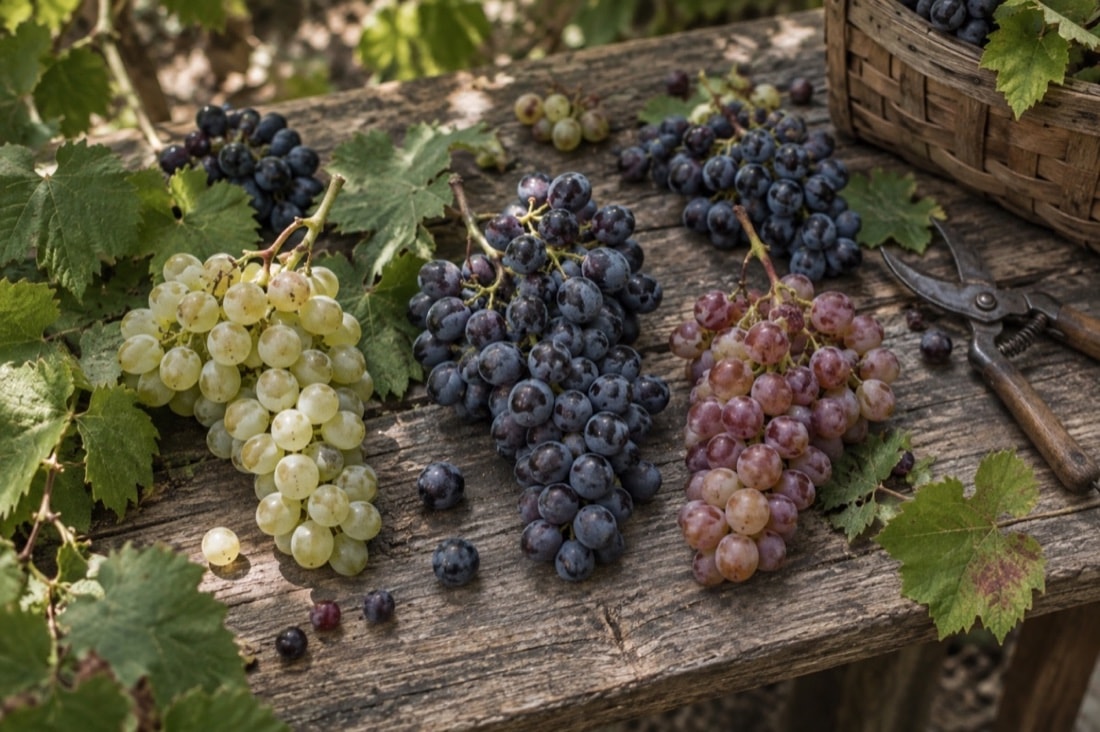
South Tyrol’s varieties form a map of its topography. Warm sites around Bolzano support grapes that need a long season, while cooler and higher vineyards give white varieties and Pinot Nero a different pace of ripening. The official regional guide presents more than twenty varieties and identifies Vernatsch and Lagrein as the area’s indigenous anchors. Its overview of South Tyrolean grape varieties is a useful companion to the bilingual names below.
Vernatsch / Schiava
Vernatsch is the German name most often encountered in the region; Schiava is the Italian. It is not one simple, uniform grape expression. The name covers related types, and site and yields have a strong effect on the resulting wine. Around Sankt Magdalena / Santa Maddalena, Vernatsch forms the core of the traditional red blend. The variety is typically associated with pale colour, gentle tannin and fragrant red-fruit or floral character, though this reference avoids prescribing a single sensory template.
Lagrein
Lagrein is the darker indigenous red of the Bolzano basin. It is closely linked with warm, well-drained sites, including the gravelly soils around Gries. Its deeper colour and more evident tannin make it a useful counterpoint to Vernatsch. The regional shift toward site and quality in the late twentieth century gave both local varieties renewed attention after a period in which undifferentiated volume had dominated much of the market.
Gewürztraminer and Weissburgunder
Gewürztraminer carries the name of Tramin / Termeno and is recognised for an aromatic profile that can include flowers, spice and ripe fruit. Its success still depends on balance: warmth helps aroma and ripeness, while site and picking choices determine freshness. Weissburgunder—Pinot Bianco in Italian—is less overtly aromatic. It often occupies elevated, ventilated sites where a longer season can build texture without losing definition.
Sauvignon and Pinot Nero
Sauvignon responds strongly to exposure, canopy and picking date. In cooler South Tyrolean vineyards it can retain a vivid herbal or citrus register; warmer conditions move the profile toward riper fruit. Pinot Nero, called Blauburgunder in German, is equally sensitive to site. It is commonly associated with cooler slopes and well-aerated positions where slow ripening and careful canopy work matter.
Merlot in the warmer sites
Merlot is not indigenous to the region, yet it has a long place in the warmer valley landscape. It can ripen in sites that would be less suitable for delicate high-slope whites. Its presence is a reminder that South Tyrol’s modern identity combines local varieties with grapes that travelled through European wine culture.
Names are coordinates, not guarantees
A variety name gives the first coordinate. The next questions are where it grew, at what elevation and exposure, in which soil, and under what farming choices. The same grape changes across a porphyry terrace, a limestone slope and an alluvial valley floor. For that reason, the altitude guide, Santa Maddalena study and appellation map are part of reading the varieties well.
German readers can continue at Die Rebsorten Südtirols. Key translations also appear in the German–Italian–English glossary.