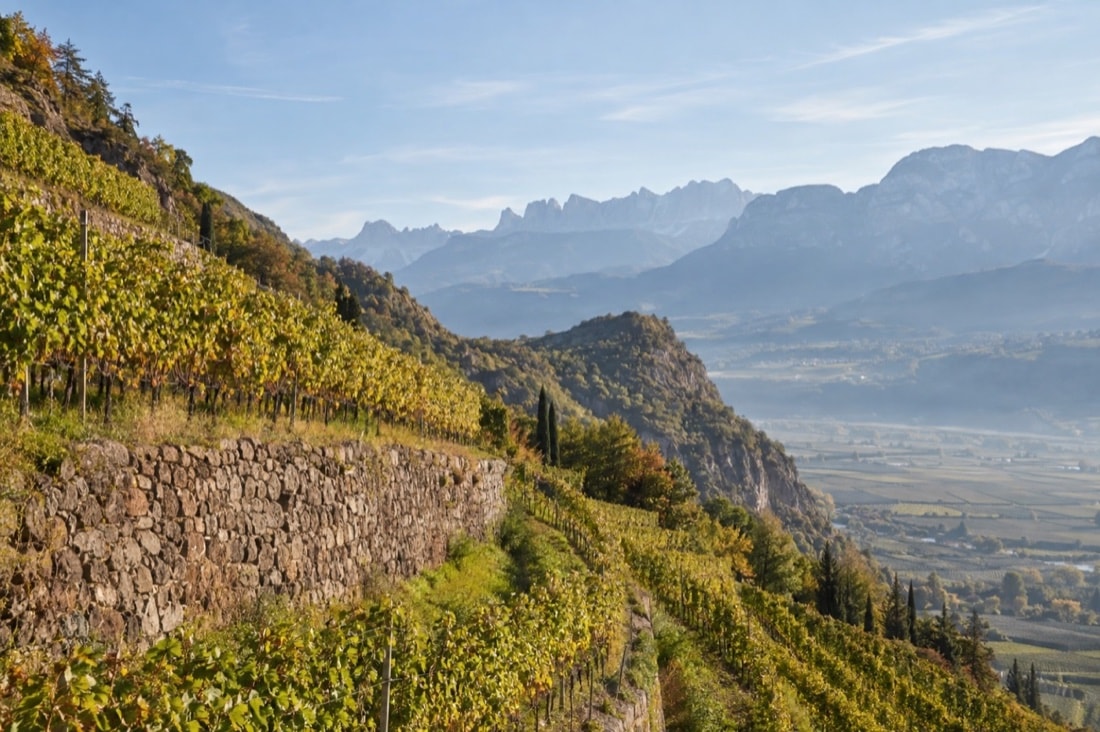
South Tyrol’s labels can look crowded because the region lives in German and Italian at once. The same origin may be expressed as Südtirol or Alto Adige, and the grape may also have two familiar names. The system becomes clearer when every term is treated as a coordinate: region first, then subzone or place, then variety and style.
Alto Adige DOC / Südtirol DOC
DOC is the Italian protected designation of origin used for wines made under a defined production discipline. In this region, Alto Adige and Südtirol are parallel names for the same bilingual territory. A DOC statement tells the reader that rules govern geographic origin, permitted grapes, yields and production. It does not say that every wine within the designation will taste alike.
European geographical-indication law provides the larger framework in which wine names are registered, protected and presented. The European Commission maintains an overview of the regulations for geographical indications. National and regional disciplines then define the details for a particular wine.
Subzones add a closer origin
The regional system includes recognised subzones such as St. Magdalener / Santa Maddalena, Terlaner / Terlano, Eisacktaler / Valle Isarco, Vinschgau / Val Venosta, Meraner / Meranese and Bozner Leiten / Colli di Bolzano. A subzone narrows the map and may narrow the permitted varieties or production rules. It is not the same thing as an individual vineyard.
Santa Maddalena offers a useful example. The geographic name points toward the warm slopes above Bolzano and a Vernatsch-led red tradition. To understand it, read the subzone with the grapes and terrain rather than as a decorative phrase. The Santa Maddalena place study supplies that context.
The Weinstrasse / Strada del Vino
The Südtiroler Weinstrasse—Strada del Vino dell’Alto Adige—describes the wine road through the southern part of the region. It is a geographic and cultural route, not a separate appellation tier. Towns, vineyards and different soil zones sit along it, from the area around Bolzano toward the Unterland / Bassa Atesina.
That distinction matters because tourism language and legal-origin language often appear beside each other. A road can orient the reader; a DOC term carries regulated meaning. A village name can do both cultural and geographic work, while a named vineyard may be more precise still.
Grapes in two languages
Vernatsch and Schiava refer to the same regional family of grapes. Weissburgunder is Pinot Bianco; Blauburgunder is Pinot Nero. Gewürztraminer keeps a recognisable form across languages, while its association with Tramin / Termeno adds another place-name layer. The trilingual glossary puts these pairs side by side.
A reliable way to read the hierarchy
- Identify the protected regional designation.
- Look for a subzone, village or additional geographic unit.
- Translate the grape name if necessary.
- Separate legally defined origin from descriptive language.
- Use vintage and cellar details as context, not as part of the geographic hierarchy.
This method keeps bilingual richness from becoming confusion. It also directs attention back to the physical vineyards explored in the altitude guide and the varieties described in the grape reference.