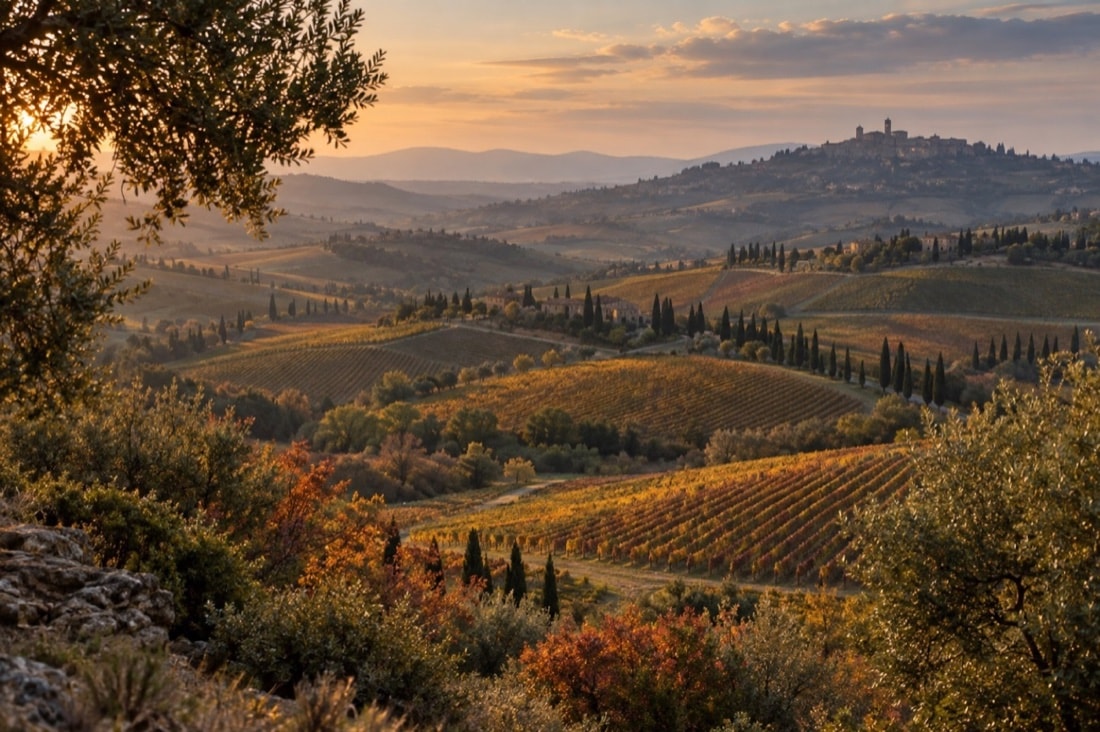
Biodynamic principles travel, but they do not erase geography. Tuscany makes that clear. Montalcino is an inland hill territory organised around Sangiovese and a tightly defined appellation. The Maremma opens westward toward the coast, with lower relief, sea influence and a broader mix of grapes. Both regions support organic and biodynamic farming, yet the daily problems of soil cover, water, wind and ripening differ.
Montalcino: elevation within a warm region
Montalcino’s vineyards occupy rolling and sometimes steep ground around the hill town. Elevation and exposure create meaningful temperature and ripening differences within a broadly Mediterranean climate. Woodland and scrub interrupt the vineyard blocks, while soils vary across the territory. Sangiovese responds to those contrasts in vine growth, skin development and the pace of maturation.
Brunello di Montalcino is made from Sangiovese, the grape traditionally called Brunello in the area. The official Brunello consortium’s appellation guide explains the production area and principal rules. Those rules belong to the appellation as a whole and should not be confused with the methods of any one estate.
Organic and biodynamic work on the hills
Dry periods make competition from cover crops a practical concern. Some growers maintain year-round cover; others mow, roll or cultivate strategically as water conditions change. Compost must be delivered across slopes without compacting wet ground. Canopy decisions balance sunlight, ventilation and protection from heat.
Biodynamic preparations and calendars sit within that ordinary agronomy. A calendar preference may shape timing when conditions allow, while soil moisture and disease pressure determine whether work can wait. The value of the framework is tested in how well it responds to the actual parcel.
The Maremma: a coastal counterpoint
The Maremma stretches across southern coastal Tuscany, where vineyards meet pasture, woodland, Mediterranean scrub and open plains. Maritime air, wind and dry summers distinguish it from both Montalcino and the Alpine valleys. Morellino di Scansano centres on Sangiovese under its local Morellino name, while Maremma Toscana DOC permits a wider range of varieties and styles.
On the coast, soil cover can protect structure and biodiversity but also compete for limited water. Wind can reduce humidity and disease pressure while increasing evapotranspiration. Exposure to salt-laden air varies by distance and landscape. Organic management therefore depends on matching ground cover, cultivation and canopy to each site rather than following a fixed visual model.
What the comparison teaches
South Tyrol, Montalcino and the Maremma share questions about living soils, external inputs and farm identity. Their answers cannot be identical. Alpine terraces prioritise slope access, short distances and vertical climate bands. Montalcino works through hill exposures and a Sangiovese-centred appellation. The Maremma adds coastal wind, open scale and summer dryness.
That is why this Tuscan section remains secondary to the site’s South Tyrolean focus yet still belongs here. It shows biodynamics as a place-responsive agricultural method, not a style imposed from above. Continue with the dedicated legacy articles in German, Italian and English, or read the Italian Maremma reference.